

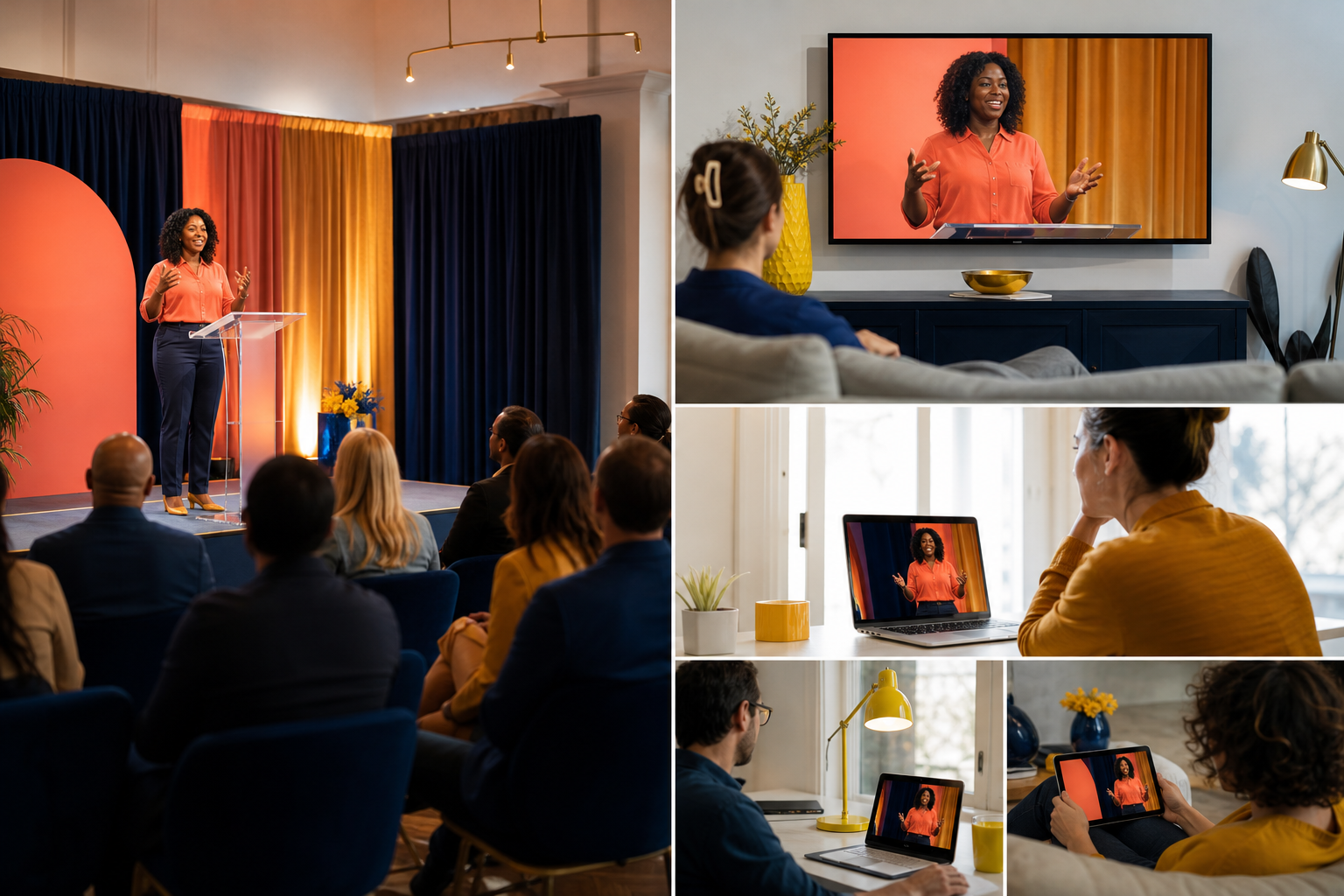
Virtual Keynote Speakers vs. In-Person: When to Use Each Format and What to Expect
Virtual and in-person keynotes are not interchangeable. One isn’t better than the other. The format you pick changes what your audience experiences, how much energy you can build in the room, and what kind of follow-up work you’ll need to do afterward.
Here’s what matters: picking the wrong format wastes your budget and leaves your team underwhelmed. Picking the right one turns a speaking engagement into a catalyst for real change.
What’s the actual difference between virtual and in-person speaking?
In-person keynotes happen in a room. You’re on stage. People are in seats. The energy is live, unfiltered, and immediate. You read the room in real time. You adjust your pace, your jokes, your emphasis based on what you see. If someone’s checking their phone, you feel it. If the room is locked in, you feel that too.
Virtual keynotes happen through a screen. Your audience is distributed. Some are in their offices, some at home, some in a conference room watching together. You can’t see most of them. The connection is mediated by technology. The energy is different because the feedback loop is broken or delayed.
The core trade-off is presence versus reach. In-person gives you intensity and connection. Virtual gives you scale and flexibility.
When does in-person keynote speaking actually make sense?
In-person works when you need the room to feel like something is happening. Sales kickoffs, company retreats, annual conferences, town halls where culture matters. These are moments where people need to feel the shift in the air, see the speaker’s face clearly, and know that everyone around them is experiencing the same moment at the same time.
In-person also works when your audience is geographically clustered. If your team is in one office or your conference is in one city, the logistics are clean. Everyone shows up. You deliver. The energy compounds.
The downside is cost and logistics. Travel, venue setup, technical requirements, scheduling across time zones if you have a distributed team. And if your audience is spread across the country or the world, in-person doesn’t scale.
When should you go virtual instead?
Virtual keynotes work when your audience is distributed and you need to reach them where they are. Multi-office companies, national or international teams, hybrid workforces. You can reach 500 people across five states without asking anyone to travel.
Virtual also works when you need flexibility. You can record it. You can reuse it. You can schedule it around people’s calendars instead of forcing everyone into one time slot. And if your team is already managing remote work, a virtual keynote feels native to how they actually operate.
The catch is that virtual requires more intentional design. The speaker has to work harder to create connection through a screen. The audience has more friction to stay engaged. Distractions are everywhere. So the content, the pacing, the visuals, and the pre-event customization all matter more.
How do you actually deliver a virtual keynote that lands?
Virtual speaking is not just in-person speaking on Zoom. The format demands different choices.
First, your visuals need to work on a small screen. Slides that look fine on a projector become unreadable on a laptop. Your camera angle matters more because it’s the only thing people see. Your eye contact with the camera is your eye contact with the audience.
Second, pacing changes. In-person, you can hold a moment of silence and it feels powerful. Virtual, silence feels like a technical glitch. You need to move faster, change visual elements more often, and build in interactive moments so people stay present. Think of effective communication techniques for virtual teams as your foundation here.
Third, the pre-work matters more. With in-person, people show up and the room does some of the work for you. With virtual, you need to send prep materials, set expectations, and create a reason for people to actually show up on time and stay focused. That’s why boosting efficiency in virtual meetings starts before the meeting begins.
Pro tip: If you’re going virtual, test your setup with your audience beforehand. Technical hiccups kill credibility. A smooth, professional virtual experience beats a chaotic in-person one every time.
What about hybrid events? Can you do both at once?
You can, but it’s harder than it looks. Hybrid events ask you to serve two audiences at once: the people in the room and the people on the screen. Your attention splits. The energy in the room can feel disconnected from the energy online. The tech has to work perfectly or one group gets a bad experience.
If you’re running a hybrid event, commit to it fully. That means good camera angles, professional audio so remote attendees can hear clearly, engagement tools that include both groups, and a speaker who’s trained to play to both audiences simultaneously. Half-hearted hybrid is worse than picking one format and doing it well.
How do you choose the right format for your specific event?
Ask yourself three questions:
- Where is your audience? If they’re in one place, in-person is simpler. If they’re spread out, virtual scales better.
- What outcome do you need? If you need to shift culture or build energy, in-person has an edge. If you need to reach a large distributed team or create a recording for future use, virtual wins.
- What’s your budget and logistics capacity? In-person costs more upfront. Virtual requires more production sophistication.
There’s no wrong answer. The wrong answer is picking a format and then not committing to what that format actually requires.
| Factor | In-Person | Virtual |
|---|---|---|
| Energy and presence | High, immediate, unfiltered | Requires deliberate design |
| Reach and scale | Limited by venue and travel | Unlimited, distributed |
| Cost | Travel, venue, logistics | Production, platform, tech support |
| Flexibility | Fixed date and location | Recordable, schedulable, repeatable |
| Audience focus | High, fewer distractions | Lower, more friction to stay engaged |
| Follow-up impact | Relies on momentum and memory | Can be reinforced with recordings and materials |
Frequently Asked Questions
Can you record an in-person keynote and use it as a virtual one?
Technically yes, but the result usually feels flat. An in-person keynote is designed for a live room. The energy, the pacing, the jokes, the pauses all assume immediate feedback from an audience. A recording of that feels like watching someone else’s event, not experiencing your own. If you want a virtual version, reshoot it or adapt it intentionally for the format.
How long should a virtual keynote be?
Shorter than in-person. In-person, you can hold attention for 45 to 60 minutes if the energy is right. Virtual, 30 to 40 minutes is the sweet spot. After that, attention fragments. If you need more time, build in a break or split it into segments with interactive elements in between.
What’s the best platform for a virtual keynote?
Zoom, Teams, or a dedicated webinar platform all work. Pick based on what your audience already uses and what features you need. Make sure your speaker can see engagement metrics or chat in real time so they can adjust. Test the platform beforehand with your technical team.
Do virtual keynotes get lower attendance than in-person?
Not necessarily. Virtual can actually increase attendance because there’s no travel friction. But virtual has higher no-show rates because people can cancel at the last minute with no consequence. Send reminders, make the value clear, and consider making attendance part of the workday so it’s non-negotiable.
Can you do a keynote hybrid if most people are in one room?
Yes, but don’t pretend the remote people are getting the same experience. They’re not. If 90% of your audience is in the room and 10% is remote, treat it as an in-person event with a remote option, not a true hybrid. The speaker’s attention will naturally go to the room, and that’s okay as long as you’re honest about it.